ALE
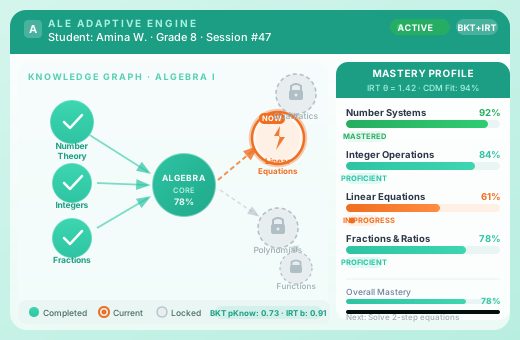
ALE uses a triple-model diagnostic architecture — Bayesian Knowledge Tracing, Item Response Theory, and Cognitive Diagnosis Models — to deliver a Socratic AI tutor that meets each student at their exact level of understanding and never advances until mastery is confirmed.
Key Features
Precision-targeted adaptive learning powered by three converging diagnostic models and a Socratic AI that never gives the answer away.
Socratic AI Tutor
The tutor never gives the answer. It asks questions, provides analogies, and scaffolds reasoning — nudging students toward insight rather than delivering it. Conversation style adapts between Socratic dialogue, worked examples, and practice problems based on student response patterns.
Triple-Model Diagnostics
BKT (Bayesian Knowledge Tracing) estimates mastery probability over practice sequences. IRT (Item Response Theory) calibrates item difficulty to student ability. CDM (Cognitive Diagnosis Model) identifies which specific sub-skills are deficient. Each model votes against a mastery threshold, and a weighted combination decides the verdict; when the vote splits past a disagreement threshold the case is queued for an educator, who sees all three inputs. The combination rule, the thresholds and the tie-break are specified in ADR 005.
Knowledge Graph Backtracking
A directed prerequisite graph covers all STEM topics K1–University. When a student is stuck, ALE traces backwards through the graph to find the earliest unmastered prerequisite. Returns the student to that foundation before reattempting the blocking concept.
FSRS Spaced Repetition
Free Spaced Repetition Scheduler (FSRS-6) schedules review sessions for all mastered concepts. Forgetting curves computed per student per concept. Review items surface just before predicted forgetting.
Affect Detection
Detects frustration and disengagement from typing cadence, response time, and error patterns — no camera required. When frustration is detected, the tutor shifts to easier problems, offers encouragement, and flags for teacher review. Privacy-preserving by design.
LTI 1.3 / xAPI Integration
Drop ALE into any LMS via LTI 1.3 Advantage — Moodle, Canvas, Blackboard, or custom. All learning events published as xAPI statements to any LRS. Exports OneRoster-style gradebook CSV for class roster exchange.
Technical Specifications
Pedagogical Models
- Bayesian Knowledge Tracing (BKT)
- Item Response Theory 3PL model
- DINA Cognitive Diagnosis Model
- FSRS-6 spaced repetition scheduler
Curriculum Coverage
- Mathematics K1–University
- Physics, Chemistry, Biology O/A level
- Computer Science (K12 + University)
- Kenya CBC, IGCSE, IB, A-Level
Integration
- LTI 1.3 Advantage (Deep Linking, Assignment & Grade Services)
- xAPI 1.0.3 to any LRS
- OneRoster-style gradebook CSV
Accessibility
- WCAG 2.1 AA target
- Screen reader compatible
- USSD mode for feature phones
- Offline PWA mode (Service Worker)
Integrate ALE into your institution
Contact our team to discuss your requirements. We respond within 24 hours.